
Transforming Cardiovascular Care with Predictive Intelligence: A Conversation with Joe Makoid, CEO of Voythos
Feb 25, 2026
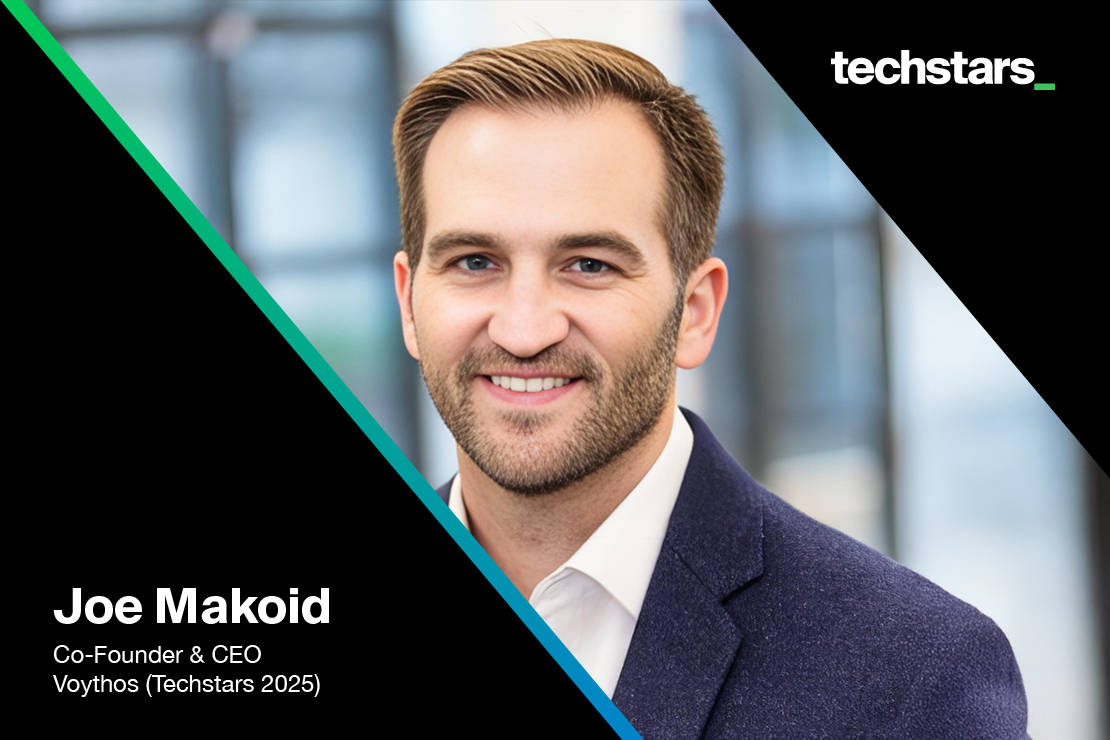
Voythos (Techstars 2025) is a Houston-based multimodal machine learning platform designed to predict and prevent life-threatening complications in complex cardiovascular disease, starting with aortic pathologies. By combining medical imaging with clinical data, Voythos builds a "digital vascular surgeon" to help clinicians intervene sooner and save lives.
Emilie Vallauri, Global Program Manager at Techstars, sat down with Joe Makoid, co-founder and CEO, to discuss the personal journey behind the company, the challenge of securing clinical data, and how a partnership with Northwestern Medicine and Techstars is accelerating their mission.
Emilie Vallauri: Could you start by introducing yourself and telling us how you ended up as an entrepreneur?
Joe Makoid: I’m Joe Makoid, CEO of Voythos. My career has been in MedTech for about 14 years now. I actually started in corporate finance at Johnson & Johnson right out of college, but I realized very quickly that sitting behind a cubicle typing out spreadsheets wasn't for me long-term.
I eventually transitioned into medical device sales, where I was in the operating room every day working with surgeons and surgical care teams. I loved the impact you could have there. Later, I joined a startup called C-SATS that J&J acquired, which was using computer vision on surgical video to help surgeons improve their technical skills in the operating room. Working with those founders humanized entrepreneurship for me — it made me realize that these were just regular people like me, and that starting something was actually achievable.
Emilie: How did the idea for Voythos specifically start?
Joe: It really started with a pain point my wife, Sophia, was experiencing in her own practice as a vascular surgeon. She was deeply dissatisfied with the "guessing game" surgeons often have to play with aortic disease. She felt like relying too much on "gut intuition" wasn't enough when patients' lives are on the line.
One day, we were sitting on the couch and she was complaining about a specific hurdle, and I just said, "Well, let’s go build something to fix it." That was the initial seed. We met our CTO, Jordan Graves, online, which helped us bring the technical density we needed to the team.
Emilie: And so it started! Now, in simple terms, what does Voythos do and why is it so important?
Joe: We build predictive models for vascular disease — what we call the "digital vascular surgeon." We’re starting with the aorta, but it will expand to carotid artery disease (a cause of stroke) and peripheral artery disease (a cause of limb ischemia).
Cardiovascular disease claims a life every 34 seconds in the U.S. It’s the leading cause of death globally. If we can predict exactly what is going to happen to a patient in the next 48 hours or 90 days, we can intervene at the precise optimal time.
Emilie: What was the biggest challenge you faced while building the product?
Joe: By far, the biggest challenge was getting the data to train the models. You can't just use publicly available data for this; you need granular, minute-to-minute blood pressure, heart rate, patient history, and imaging.
We solved this through key partnerships. First, the Mayo Clinic Platform Accelerate program gave us access to real EHR-level data, which provided us with immense credibility. Then, our partnership with Northwestern through Techstars gave us access to their data, and we used a chunk of our investment to purchase a dataset of 1.6 million patients to further enhance our models.
Emilie: Apart from those incredible partnerships you just mentioned, what sets Voythos apart from other AI companies in the healthcare space?
Joe: A lot of companies focus on detecting the presence of an existing disease, which is valuable. But we care most about what is going to happen to the patient. We are building "patient trajectory models" that predict how a disease will progress from month to month. Combining that predictive focus with the unique clinical insight of having a vascular surgeon as a founder is our major advantage.
Emilie: You’ve hit some major milestones recently. What’s next for 2026?
Joe: We’ve seen very encouraging results from our latest model training — predicting certain outcomes with over 95% accuracy.
For 2026, the goal is execution. We want to get this product into surgeons' hands at five to ten different institutions. We are also talking about putting together a seed round during the year, but that depends on the rollout and whether we move toward immediate revenue or a clinical validation pathway.
Emilie: Any other recent news you're proud of?
Joe: One of the most prominent vascular surgeons in the U.S. is joining us as an angel investor. Having someone of his stature on the cap table alongside institutions like Northwestern and Mayo Clinic is a huge milestone for us.
Emilie: Let’s turn to your journey as a founder for a minute. What motivates you to keep going on the hard days?
Joe: It’s twofold. First, I’m motivated by the mission. Healthcare spending in the U.S. is at an unsustainable pace, and outcomes don't always match what we spend. Fixing even a small piece of that is incredibly meaningful.
Second, on a personal level, it’s an obsession with accomplishing something really, really hard. Building something from the ground up is my baby. Believing in our team and "climbing that mountain" is what keeps me going.
Emilie: Finally, I’m curious about your experience at Techstars. Why did you decide to participate in the accelerator, and how has it helped?
Joe: The industry-specific vertical was the most enticing part. We wanted deep expertise on how to integrate with a large health system like Northwestern Medicine. It wasn't just a vendor relationship; it was an invested stake to help us accelerate. Having Northwestern as an LP in the fund meant our incentives were perfectly aligned, which was a huge factor in our decision.