
Revolutionizing Industrial Automation: A Conversation with Phillip Hansel of Ai-OPs
Feb 18, 2026
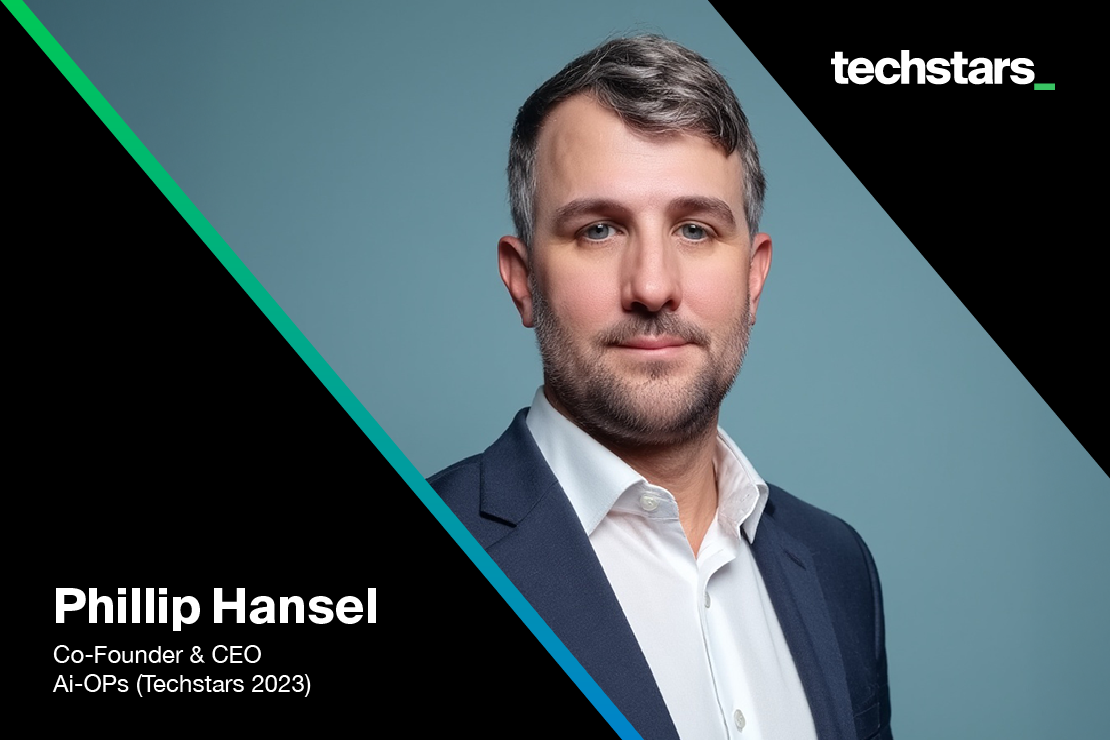
Ai-OPs (Techstars 2023) is changing the face of engineering by applying deep reinforcement learning to complex industrial systems. From optimizing refrigeration in UK grocery stores to managing steam valves for major power utilities, the company is proving that AI can make heavy industry safer, more efficient, and more sustainable.
Emilie Vallauri, Global Program Manager at Techstars, sat down with Phillip Hansel, CEO and co-founder of Ai-OPs, to discuss the company’s origins, their unique product-led approach, and the "unnatural" journey of being an entrepreneur.
Emilie Vallauri: To start off, can you introduce yourself and tell us how you ended up becoming an entrepreneur?
Phillip Hansel: I’ve been a control systems and automation engineer for 16 years, but the entrepreneurial spirit has always been there. In college, I ran a tile company, and more recently, my wife and I — who is also an entrepreneur — started a successful gym during COVID. Having a partner who understands that this path isn't easy is beneficial because you really need that support staff of family or friends.
Emilie: How did Ai-OPs come to be? How did your founding team meet?
Phillip: The idea started back in 2012. Three of the four co-founders — Connor Smith (Chief Product Officer), Ryan Hutchison (Chief Technology Officer), and I — were automation engineers working together at a systems integration company. We were "in the trenches" together, building gas facilities and chemical plants.
Around 2014, we saw a legendary Google video of an AI agent learning to play the game Atari Breakout. It didn't just play; it learned to optimize and win as quickly as possible. We realized that was exactly what we needed for industrial automation. We later brought on our fourth partner, Curtis Wright (our Chief Analytics Officer), who came from Chevron and brought the machine learning expertise we needed to turn that theory into a safe, reliable industrial product.
Emilie: What exactly does Ai-OPs do, and why is it important for the industry?
Phillip: We are an AI platform company for industrial control systems. We use deep reinforcement learning to help facilities make real-time decisions to optimize their processes.
A great example is our work with grocery stores like Asda in the UK. Refrigeration is a very challenging physics problem. By letting our AI "virtual operator" take control of the valves and compressors, we’ve seen a 20% reduction in energy usage and an 80% reduction in maintenance costs. When you scale that across 700 stores, the impact is tremendous.
Emilie: You have several products — Ronin and Koios — plus engineering services. How do they work together?
Phillip: Ronin is our platform for building, training, and sustaining models. It handles the data management so engineers can develop their own solutions. Koios is the "inference station." It’s designed to run on-site, even disconnected from the internet, where it can manage hundreds or thousands of AI models concurrently.
While we do some engineering services to show the "art of the possible," we are ultimately product-led. We want engineers to use our platform to solve their own problems.
Emilie: What sets you apart from competitors in this space?
Phillip: On the refrigeration side, we are currently the only ones who have successfully used deep reinforcement learning for control and templatized it so it can be copied and pasted to any store.
More broadly, we are an outlier because we have the deep industry knowledge required to make these solutions relevant. Even if someone else figures out the AI methodology, they still need a platform like Koios to actually run it safely in an industrial environment.
Emilie: I want to touch on your momentum for a minute. Can you tell us about your partnership with Alabama Power?
Phillip: They’ve been a fantastic partner. For a utility company, the risk of new technology is high — you can't just knock out the power for a corner of the state. They’ve taken a responsible approach, starting us at the National Carbon Capture Center on a project for steam optimization. We are working with their team to develop a workflow they can eventually scale across their entire organization for things like grid balance or improving water quality.
Emilie: We are in January 2026. Building on the success you’ve experienced in 2025, what are the next steps for Ai-OPs in the new year?
Phillip: 2026 is about scaling. We are expanding in the grocery sector globally — the US, Southeast Asia, and the UK. We’re also moving into offshore oil and gas and the chemical industry. We are actually wrapping up a fundraising round this month, with Alabama Power’s investment arm participating as a partner.
Emilie: Turning to your journey as a founder: starting a company is hard! What motivates you on the hard days?
Phillip: You have to believe in what you’re doing. Entrepreneurship is the most "unnatural" thing you can do to yourself; there are many easier ways to make money. But we have a passion for the people and the engineering jobs this improves. You have to believe that if you don't do it, the thing dies. Knowing we are affecting bottom lines and the environment in a positive way is the "pie in the sky" motivation, but hard work, commitment, and patience are what turn it into reality.
Emilie: And to finish up this interview, I’d love your view on the Techstars Accelerator. How did participating in the cohort help grow the company?
Phillip: Our Managing Director, Matthew Jaeh, was very beneficial. We were "comfortable" bootstrapping on nights and weekends, and he pushed us to realize we wouldn't grow until we were uncomfortable. He was very direct with me, engineer to engineer. Techstars took a risk on us before we even went full-time, and it’s been a great success.