From Techstars to CES: How HapWare Turned Acceleration into Momentum
January 15, 2026
At this year’s CES, HapWare (Techstars 2025) experienced a week that demonstrated just how far it had come as a company — and how much they had learned through Techstars.
By Bryan Duarte, Ph.D., Co-Founder and CTO of HapWare
HapWare (Techstars 2025) empowers people who are blind or neurodivergent to better navigate social interactions at school, at work, and at home. Using our patent-pending haptic feedback wristband ALEYE and smart glasses, we translate non-verbal social signals — facial expressions, body language, and emotional sentiment — into intuitive vibration patterns, delivered subtly and in real time to support confident, autonomous engagement.
A Defining Week at CES
The Consumer Electronics Show (CES) is the world’s largest annual technology trade show, bringing together innovators, investors, and industry leaders from across the globe. At this year’s CES, held January 6-9 in Las Vegas, HapWare experienced a week that demonstrated just how far we had come as a company — and how much we had learned through Techstars.
Over the course of the week, we:
Were featured in Eureka Park as winners of the CTA Eureka Park Accessibility Contest, showcasing HapWare to attendees, media, and industry leaders
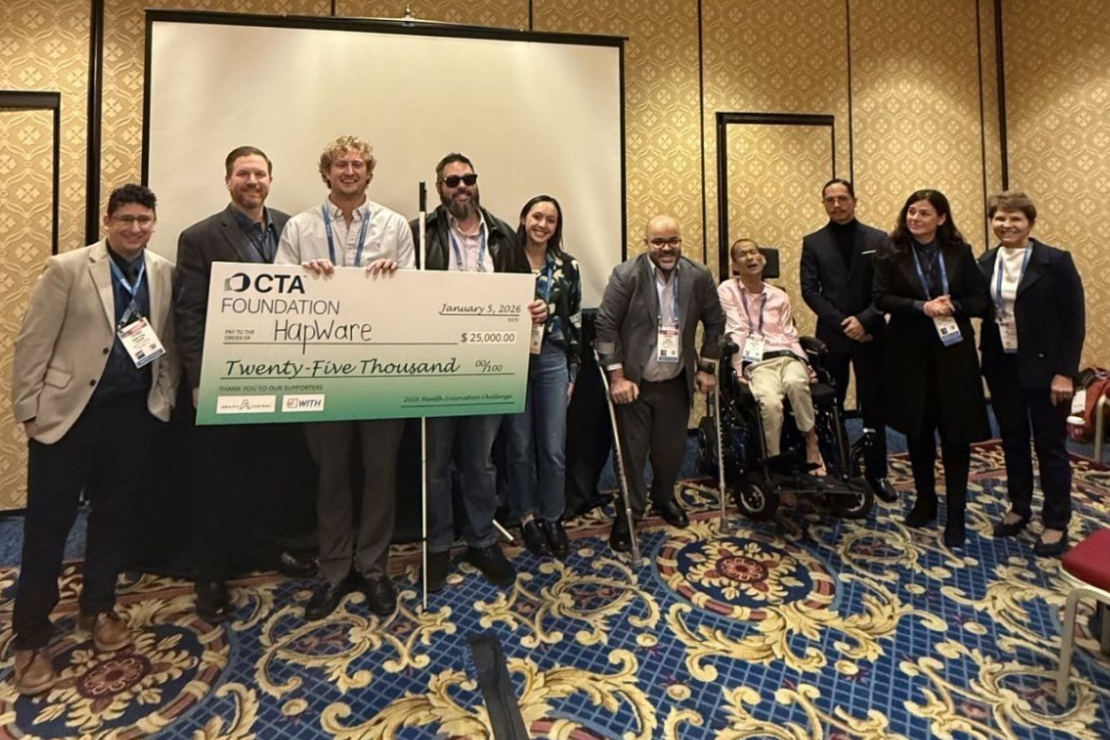
Pitched and won the CTA Innovation Challenge focused on technologies supporting the intellectual and developmental disabilities (IDD) community, earning a $25,000 grand prize
Were featured on the CES Accessibility Stage, both as Innovation Challenge winners — with our CEO presenting HapWare’s mission — and through a public callout from Meta during a wearables panel
Received broad media attention, including an Engadget feature, appearances across three TV news segments, and interviews with multiple podcasts and YouTube channels — along with interest from a Shark Tank casting scout who followed up about the possibility of HapWare appearing on the show
Welcomed a few legends to our booth, including Stevie Wonder and Palmer Luckey, both of whom took time to try our technology firsthand
It was a massive week — and an ideal way to kick off our first fundraise. But what became clear to us on the CES floor was that none of this happened by accident.
The momentum we carried into CES was built intentionally over the months leading up to it, inside the Fall 2025 class of Techstars San Diego Powered by SDSU.
How Techstars Prepared Us for CES
Our journey to CES began earlier than we realized. Just two weeks into the Techstars program, while attending Foundercon in Boulder, we learned that HapWare had won the CTA Eureka Park Accessibility Contest. The win came with a complimentary booth at CES, additional promotion and media coverage, and hands-on support from the CTA team.
It was an incredible opportunity — and an intimidating one. CES would begin on January 6, barely a month after Techstars Demo Day. The timeline was tight, expectations were high, and we had a lot of work to do.
As the program progressed, particularly during Mentor Magic, CES became a recurring focus in our conversations. We began to understand just how pivotal the event could be if we showed up prepared: with strong demos, a polished product, and a clear story. At the same time, we were racing toward Demo Day — forcing us to refine not just what we were building, but how we talked about it.
Techstars pushed us to prepare for the reality of CES itself: rapid-fire conversations, concise elevator pitches, and tough, unscripted Q&A. Through repeated pitch practice, mentor feedback, and constant iteration, we learned how to clearly explain HapWare’s value in under a minute — whether we were speaking to an investor, a journalist, a potential partner, or a first-time user.
That preparation quickly revealed a second, equally important challenge: what we were saying on the CES floor needed to be matched by what we were showing. Bridging the gap between our scrappy working prototype and a product refined enough for both Techstars Demo Day and a global stage like CES became a central focus of the program.
Mentorship that Made the Difference
Closing that gap required targeted mentorship — each connection helping us solve a very specific piece of the problem.
Prior to Techstars, we had been building our own glasses, but one of our major goals entering the program was to partner with an established smart-glasses platform. Meta was our number one choice — and through John Iaia, Head of Strategic Alliances for AI & XR at Lenovo, we were connected with Meta and joined their Alpha program for early software development on the Meta Ray-Ban smart glasses.
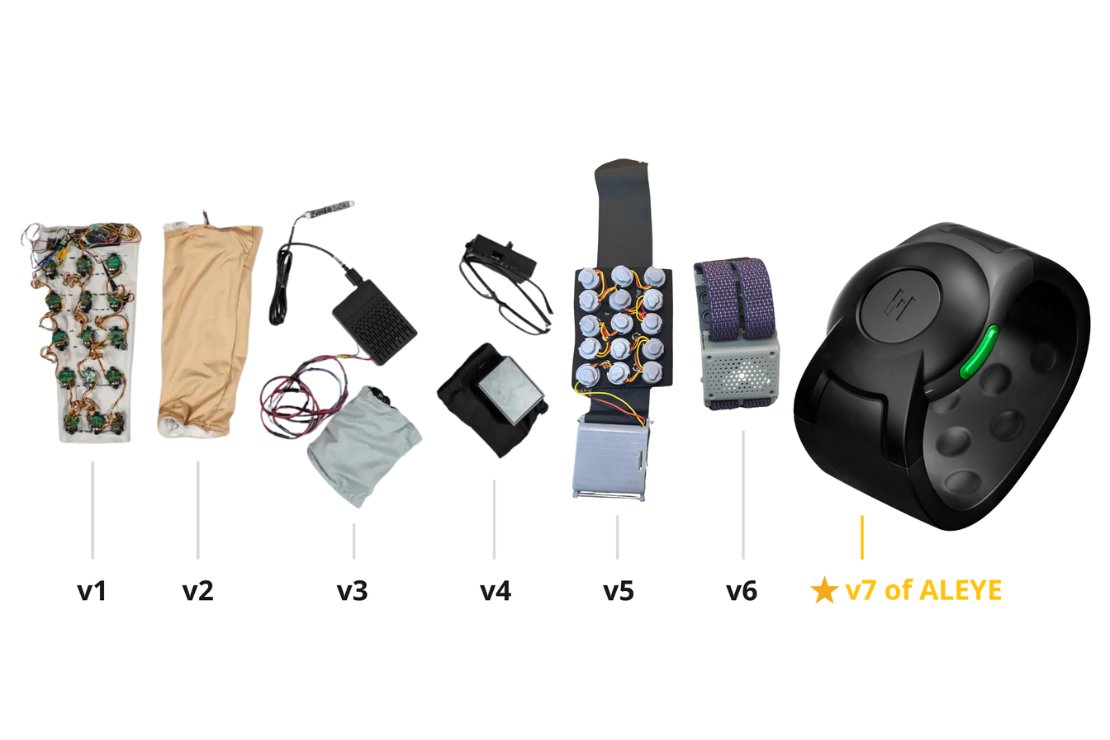
We also had a product that was functional — but, to say the least, bulky. Through Terry Arbaugh, President of KD Product Development, we met industrial designers Pete Blades and Bronson Aden of Integral8, who helped us completely rethink the form factor of our haptic wristband. Together, we reduced the size by 65%, transforming it into something sleek, wearable, and production-ready — an evolution that made a tangible difference in how people engaged with the product at CES.
We were also deeply influenced by mentors who challenged us to think beyond the immediate product.
Pankaj Kedia, an AI investor and thought leader often referred to as the “godfather of wearables” from his time at Qualcomm, consistently pushed us to define our true moat and to think expansively about where our technology could go. Those conversations led us to see our wristband not just as an accessibility device, but as a platform — a perspective that proved prescient when companies in gaming and even Boeing later approached us at CES about using our haptic drawing grid for applications like 3D simulations and training.
Ryan Kuder, a serial founder and former Managing Director of Techstars San Diego, brought a founder’s lens to nearly every discussion. His guidance on business strategy, positioning, and marketing helped us sharpen how we talked about HapWare — not just what we were building, but why it mattered and how it could grow.
Behind the scenes, the Techstars San Diego Powered by SDSU team played a critical role in helping us execute under intense time pressure. Misti Cain, our Managing Director, Hunter Haines, our Investor in Residence, and Jonah Peake, our Program Director, provided constant feedback, pressure-testing, and support — especially when it came to refining our pitch and presentation for both Demo Day and CES.
Equally impactful was going through the program alongside an incredible cohort. Our fellow founders at Klira AI, Orbes, Cytodyme, Landng, and Laibl pushed us, supported us, and made the intensity of Techstars more rewarding. The shared momentum made the wins feel collective, not individual.
Turning Preparation into Momentum
CES wasn’t just a milestone, it was a moment of validation. It brought months of learning, iteration, and preparation into sharp focus, and reinforced the value of the foundation we built during Techstars.
From Demo Day to the CES floor, Techstars San Diego Powered by SDSU gave us the structure, support, and confidence to show up prepared — and to turn a defining week into lasting momentum.


