
Techstars Mentor Anuj Adhiya on the Learning Loop Every Startup Needs but Most Lack
Jan 06, 2026
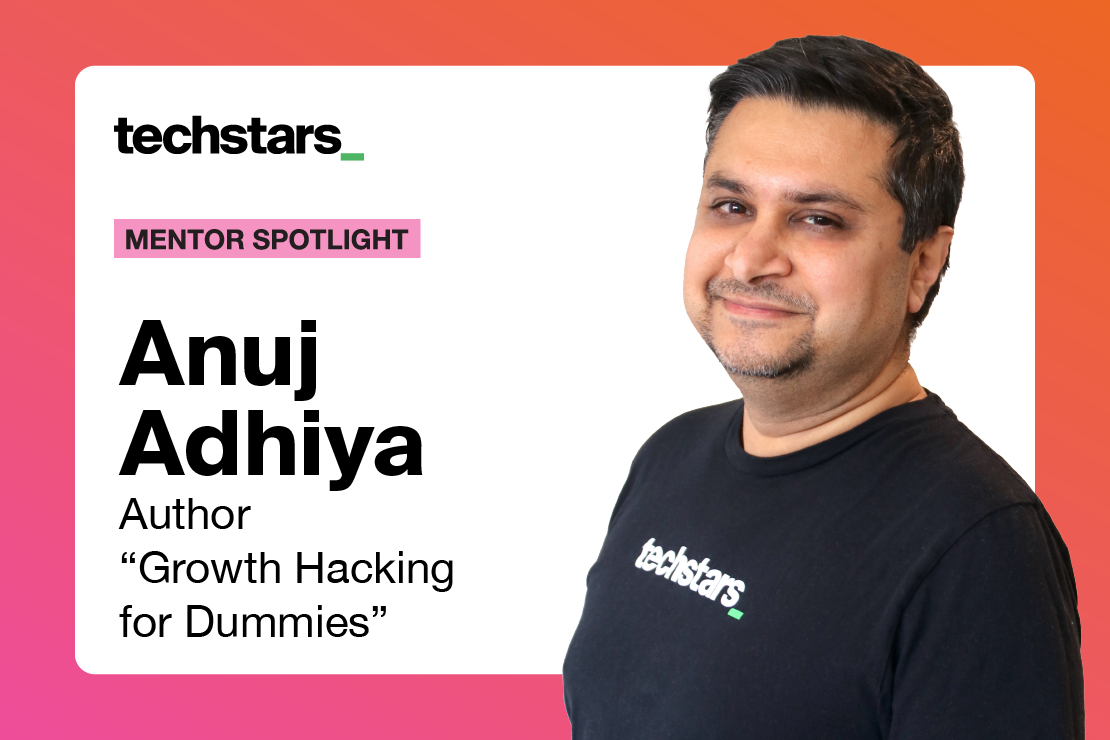
Anuj Adhiya is the author of "Growth Hacking for Dummies" (Wiley & Sons, April '20). He has extensive experience working with early-stage startups, serving as their first growth hire to streamline processes and teams. Anuj is also Mentor-in-Residence at Techstars Boston and holds mentoring positions at Harvard Innovation Labs, Seedstars, and The McCarthy(s) Venture Network.
Prior to his current roles, he held positions as the Category Growth Lead at The Predictive Index, where he successfully launched the talent optimization category, and as the Director of Engagement and Analytics at GrowthHackers, grew it into the world's largest growth community.
What advice do you find yourself giving most often to founders?
Most founders move quickly — which is necessary — but many move quickly in the wrong direction for longer than they realize. The advice I give most often is to turn conviction into short, falsifiable tests. Not “big bets,” just tight experiments that answer one real question at a time: Will this change user behavior in a measurable way or not
What I see over and over is teams debating strategy when the real problem is that they haven’t created a clean learning loop. Once that loop is in place, decisions stop feeling heavy. They become obvious.
What impact do you hope to make with the founders you mentor?
The impact I care most about is helping founders build judgment under uncertainty. Not confidence in a pitch, not fluency in metrics, but the ability to reason clearly when the data is messy, the pressure is high, and the answer isn’t obvious.
If a founder leaves knowing how to separate motion from progress, narrative from signal, and urgency from importance, that changes how they lead within their company. That’s the compounding effect I’m aiming for.
What are some of the biggest learnings from your career that you bring as a Techstars Mentor?
The biggest lesson is that growth rarely fails because of tactics — it fails because of misalignment. I’ve seen teams with strong products struggle because positioning drifted from reality, or acquisition ran ahead of activation. Everything “looked” like progress, but the system underneath was breaking.
I’ve also learned that metrics can either clarify thinking or completely paralyze it. Early in my career, I trusted dashboards too much and narrative too little. Now I look for the tension between what the data says and what the user is actually struggling with. That gap is where the real work usually is.
And finally, there’s no shortcut to product-market fit. You can outwork confusion for a few months. You can’t outrun it forever.
Describe a situation with a startup founder or team where you felt like you made a difference.
I worked with a team that was convinced their churn problem was a pricing issue. They were already under pressure to grow revenue, and pricing changes felt like the fastest lever. When we dug into their onboarding and activation flow, it became clear that most users were never even reaching the moment of value.
There was resistance at first — no one wants to slow revenue experiments — but we shifted focus to first-use experience. Within weeks, activation nearly doubled and churn dropped without changing pricing. The biggest shift wasn’t tactical. It was changing how the team reasoned about cause and effect.
What trends or innovations are you most excited about?
I’m most excited about the shift from static funnels to adaptive, intent-driven systems — especially as AI moves inside products, not just around them. We’re entering a phase where software doesn’t just execute workflows, it collaborates with users in real time.
What matters now isn’t just what the model can do, it’s whether users are actually reaching successful outcomes with it. That forces founders to rethink measurement, trust and progress in entirely new ways. The teams that get this right early will look obvious in hindsight.