
Getting the ESO Language Right, Edit or Be Edited
May 04, 2026
By Chris Heivly, Managing Director at Build The Fort and Startup Community EIR @ Techstars
Every once in a while, I hear a phrase from someone working inside an Entrepreneurial Support Organization that makes me twitch a little.
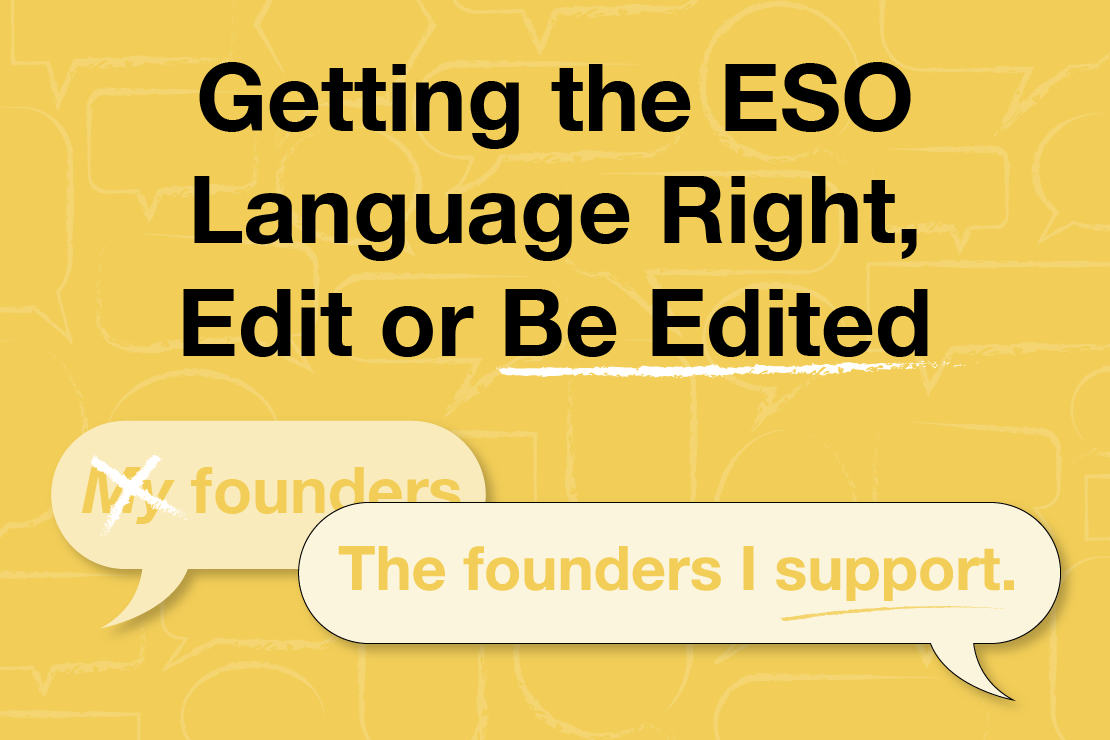
“My founders.”
As in, “I need to check in on my founders,” or “My founders are really struggling with fundraising,” or “We had 40 of my founders at the event last night.”
I know most people do not mean anything bad by it. In fact, it usually comes from a good place. ESO staff care. They work hard. They spend nights and weekends making introductions, reviewing pitch decks, finding mentors, chasing sponsors, and generally trying to make the path a little less lonely for entrepreneurs.
But words matter.
And that little word — my — carries more weight than we think.
Founders are not clients in the traditional sense. They are not users of your platform. They are not attendees of your big annual event. They are not inventory. They are not a portfolio unless you actually wrote a check and even then, tread carefully.
They are founders.
They are people taking huge risks with their time, money, reputation, family stability, emotional health, and future. They are the ones jumping off the cliff and trying to build the airplane on the way down. The ESO is not the hero in that story. The founder is.
Our role is not ownership. Our role is service.
That distinction matters because startup communities get sideways when support organizations start believing the community exists because of them. It does not. The community exists because entrepreneurs are crazy enough, bold enough, and stubborn enough to build something from nothing.
The ESO is the tail. The founder is the dog.
And when the tail starts thinking it is wagging the dog, everyone can feel it.
The language we use is often the first signal of our posture. “My founders” can quietly become “my program,” “my ecosystem,” “my wins,” and eventually “my credit.” That is a slippery little slope toward community ego, and community ego is one of the fastest ways to turn a support system into a hierarchical gatekeeping system.
Try different language.
“The founders I support.”
“The entrepreneurs in our community.”
“The founders participating in the program.”
“The people building companies here.”
It may sound like a small edit, but it changes the center of gravity. It reminds us that we are here to open doors, not hold keys. We are here to connect, not collect. We are here to serve the people doing the hard thing.
Founders do not belong to us.
We belong in service to them.
About the Author

Chris Heivly
Chris is one of the nation’s leading experts on launching startups and has been dubbed the “Startup Whisperer.” He co-founded MapQuest, is an angel investor, ran a corporate venture fund and 2 micro venture funds (directed over $75M), and was most recently SVP Innovation with Techstars. Chris just released his new book, The Startup Community Builder’s Field Guide for founders, investors and economic development leaders to better accelerate their ecosystem.