
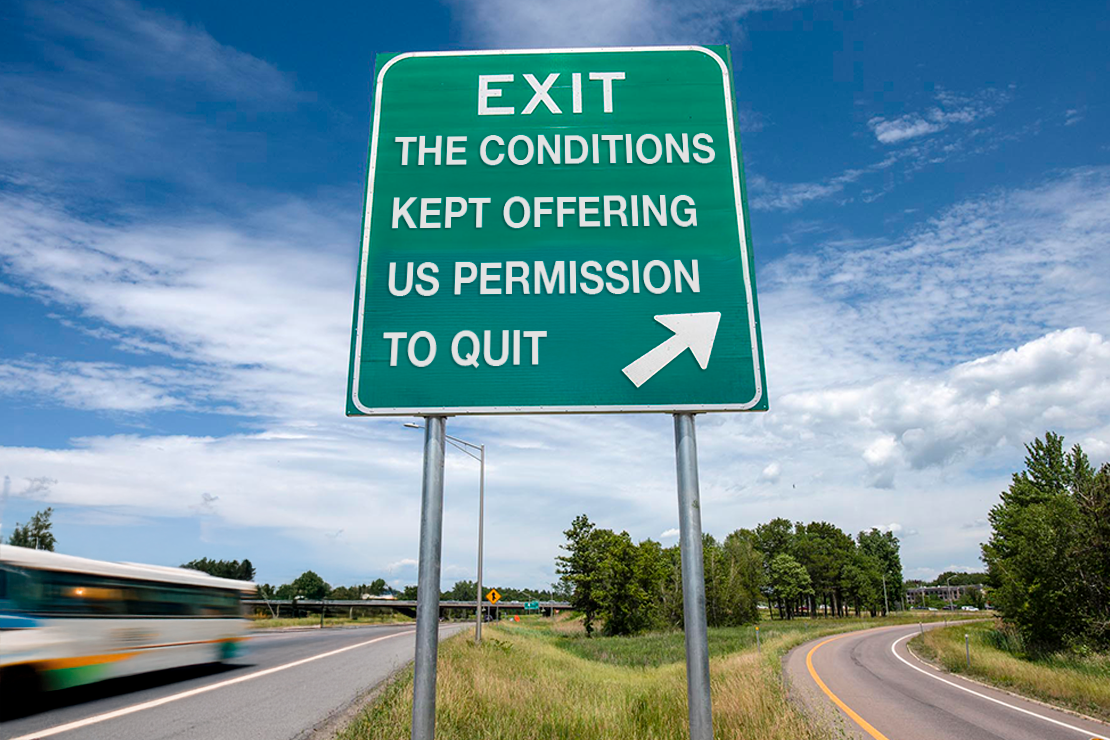
The Conditions Kept Offering Us Permission to Quit
Jun 11, 2026
By Troy McAlpin, CEO & Co-Founder, Atono
For a long stretch in the early years, I raised money $25,000 at a time. Not $25 million. Twenty-five thousand dollars, from one person, in one conversation, and then I went and did it again. It took three years to raise the first $2 million that way. I was turned down by more firms than I can count. Polite no's, slow no's, no's that arrived after three meetings that felt like they were going somewhere. Then I went and found the next $25,000.
Here is the pattern I didn't see until much later: over 21 years of building that company, the conditions kept offering us permission to quit, and we kept turning it down. The dot-com crash was permission. So was 9/11. So were three rounds of layoffs in 2008, and a buyout offer in 2012 that would have ended the grind with a respectable check. Each one was a reasonable, defensible exit. We declined all of them, and that turned out to be the whole story.
The unglamorous version of the arc is the useful one, so here it is.
The worst possible time to start
I founded the company, then called AlarmPoint, in 2000, right as the dot-com era was coming apart. The fundraising environment was already brutal. Then 9/11 hit eighteen months in, and the years that followed made brutal look generous. That was the $25,000 era. No momentum to ride, just the next check and the next month.
I wrote personal checks to cover payroll more than once. We ran on less than 90 days of cash more times than I can remember, not as a one-time scare but as a condition I learned to live inside. And for most of it, almost nobody believed in the vision. The persistence wasn't being validated by anyone. It was just stubbornness aimed in a direction I trusted.
Almost nobody is not nobody, though, and the few who believed mattered enormously. Two men backed me early: Dave Stiles and Marvin Dennis, both founders themselves. I think that's exactly why they said yes when the firms said no. They weren't betting on the concept, which was barely legible at that point. They were betting on me and the team. That's the part I wish more first-time founders understood about early money. At the beginning, nobody is funding your idea. They're deciding whether they believe you and your people will figure it out. Dave and Marvin decided we would, and I've never forgotten it.
Eventually the institutional money came too: $3.25 million from JMI Equity in 2005, another $3.5 million in 2007. After years of scraping, it felt like solid ground.
Then 2008 arrived.
2008 nearly took us out
We sold on-premises software back then, in big enterprise contracts. Our largest customers included Lehman Brothers and Barclays, names that 2008 hit at the center and hit hard. When your biggest accounts are the epicenter of a financial crisis, you feel it everywhere at once.
We went through three rounds of layoffs. If you've never had to do that, I'll only say it doesn't get easier with practice. We made it through the next couple of years on frugality that bordered on severe. We cut everything that wasn't survival, protected the customers and people we couldn't afford to lose, and kept moving forward, slowly.
Betting the company twice
By 2012, the ground had shifted. It was obvious we had to move to the cloud, and staying on-premises was a slower way of dying.
Around the same time, an acquisition offer came in. It was a low bid, priced for a company that had already given up. We turned it down. That was one of the scariest calls I've made. Saying no to a real exit after more than a decade of grinding takes a conviction that's hard to explain to anyone who hasn't sat in the chair.
What we did instead was harder than anything the crisis had thrown at us. We started with a hosted, client-specific version of the product, managed as a service. It bought time, but I knew it wouldn't scale. So we did the uncomfortable thing and started building real, bottom-up SaaS to compete with our own existing product. We rebranded from AlarmPoint to xMatters to mark the shift, then set out to make our old software obsolete before anyone else could.
We were changing almost everything at once. We shifted from a channel-led business to a direct-sales motion while moving from perpetual licensing to recurring revenue. Either transition would have been hard on its own. We attempted both while funding the future with revenue from the past. There were quarters where the math barely closed, and the team was running on conviction more than proof.
It worked. We grew the SaaS business from zero to $60 million in ARR, which was our annual recurring revenue at the time of acquisition, and in 2021 we sold the company to Everbridge. Twenty-one years after that first $25,000.
One number I'm quietly proud of: across the whole journey, total paid-in capital was just over $9 million. We didn't build on a mountain of cash. We built on frugality, persistence, and a handful of people who believed. When founders tell me they need to raise a fortune before they can build something real, I think about that $9 million.
Surviving and growing are not the same skill
Persistence alone doesn't explain the growth, and I don't want to skip the part that does. In 2015, coming out of the worst of the transition, we implemented the Jim Collins framework across the company, and it changed things.
Collins says it plainly: get the right people on the bus, in the right seats, before you obsess over where the bus is headed. Here is what that actually looked like for us. A few of the leaders who had carried us through the survival years were not the right people to scale a SaaS business, and I had known it for a while without acting. Getting disciplined meant making those changes instead of postponing them, and holding new hires to a higher bar than "can they help us survive this quarter." It was uncomfortable and overdue. It was also the moment survival turned into real, durable growth.
I bring it up because "never give up" can rot into "grind harder forever," and that was never the lesson. Persistence keeps you in the game. Discipline decides what you're persisting at. We were lucky to learn both, in that order.
The same lesson, every time
Every generation of founders believes its challenge is unique. In 2000 it was the dot-com crash. In 2008 it was the financial crisis. Today it's AI, and the noise and confusion that come with it. The technology changes. The fundamentals don't. Great people, disciplined execution, and persistence still win, and they always will.
If you're in the hard part right now, and most founders always are, here's what I'd want you to take from twenty-one years of it. Persistence is what kept us alive. Discipline is what made us grow. Those are two different things, and the second one is the one most founders underrate. The lesson is not "work harder." Plenty of exhausted teams go nowhere. The lesson is to stay in the game long enough to get the right people in the right seats, then point that team at the few things that actually matter.
Almost nobody believed in what we were building, for a very long time. The conditions kept offering us permission to quit, and we kept turning it down. Sometimes persistence is just stubbornness aimed in a direction you trust. Keep it aimed there, get disciplined about who's with you, and stay in the game.
You can't win if you give up.
Keep moving.
About the Author

Troy McAlpin
Troy McAlpin is the CEO and Co-Founder of Atono. He founded AlarmPoint in 2000, rebranded it as xMatters in 2012, and led the company through its acquisition by Everbridge in 2021.
Atono is a Techstars Growth Network Partner.