
Empowering Emerging Markets: A Conversation with Nick Fedorkiw and Ricky Buch of Powertrust
May 27, 2026
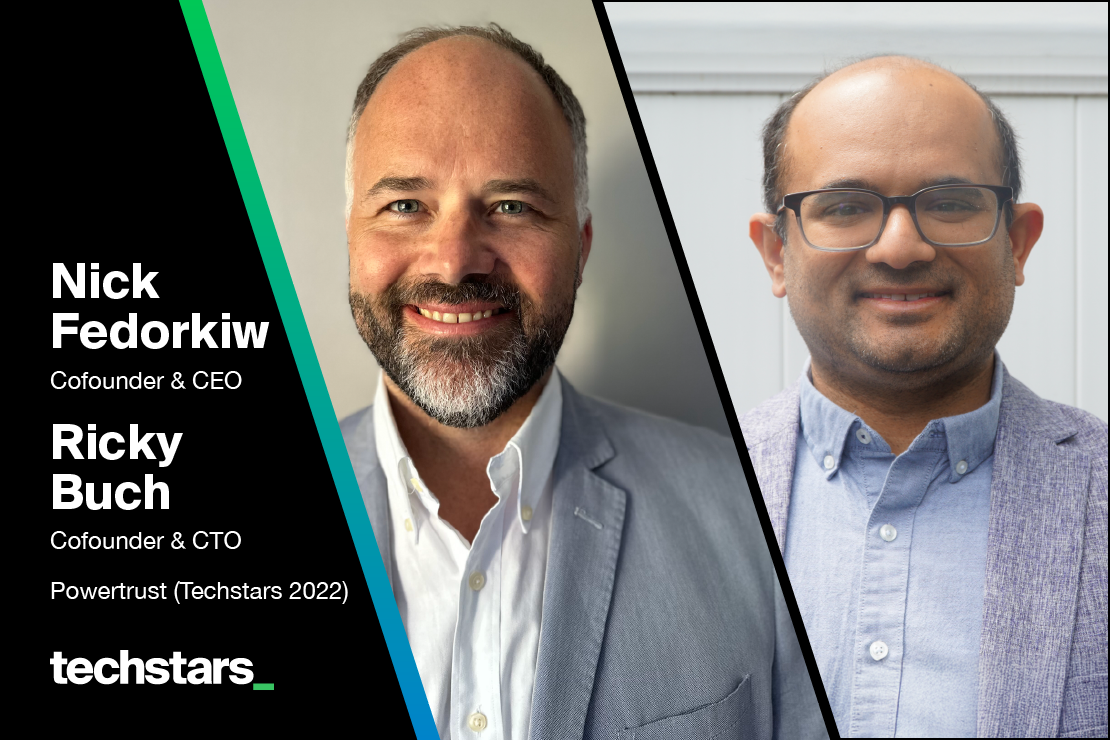
Powertrust (Techstars 2022) is a Vancouver-based energy procurement platform that is bridging the gap between global corporations and small-scale renewable energy projects. By focusing on high-growth emerging markets, the company provides the transaction infrastructure necessary for multinational organizations to meet their climate commitments while driving capital toward local solar developers.
Emilie Vallauri, Global Program Manager at Techstars, sat down with Nick Fedorkiw (CEO) and Ricky Buch (CTO) to discuss how they are leveraging technology to standardize the certification of distributed renewable energy and why the "Global South" is the next frontier for climate impact.
Emilie Vallauri: To set the scene, could you both introduce yourselves and share a bit about your backgrounds?
Nick Fedorkiw: I’m based in Vancouver, my hometown. I got started in the energy sector about 20 years ago in London, working for a company that built large offshore wind farms. My background is actually in economics, which is the perspective I bring to this work. I’ve spent my career in infrastructure, solar, and wind, but I reached a point where I saw opportunities that I simply couldn't pursue while working for someone else.
Ricky Buch: My background is originally in software engineering. I worked at Microsoft before going to business school and eventually switching to the energy space. I spent many years at General Electric in corporate strategy, where my role was to help incubate organic innovation and develop new products. My last role at GE focused on how to electrify fast-growing economies like India and Brazil, which is where I got deep into the distributed renewable space.
Emilie: How did the founding team come together, and what was the original problem you set out to solve?
Nick: We have a third co-founder, Paul Needham, who is a multi-time entrepreneur. Ricky and I met at a conference in New York, and Paul and Ricky had crossed paths while working on renewable energy in India. We officially started talking about working together around 2019.
We saw three trends colliding: large corporates wanting to buy renewable energy in emerging markets, the massive growth of small-scale "rooftop" solar, and the digitization of energy meters. Corporates were already buying 100% renewable energy in the US and Europe, but they couldn't source it in places like Africa or Southeast Asia because those markets are fragmented and the projects are too small for traditional bilateral contracts. We saw a chance to build a product that brings those two worlds together.
Emilie: Simply put, what does Powertrust do and why is it important?
Nick: We enable the biggest buyers of electricity in the world—like the hyperscalers—to buy clean energy in emerging markets where it’s most needed. This is important because it’s a multi-billion-dollar market that these companies have a strong desire to enter, but they haven't been able to until now.
Ricky: We think of ourselves as transaction infrastructure. We facilitate the end-to-end flow of capital between multinationals and small-scale developers. Specifically, we work with renewable energy credits (RECs). We originate, verify, and sell these credits from zero-carbon sources so corporates can report lower emissions.
Emilie: How does the platform actually work for the buyers and the suppliers?
Nick: It’s not a self-served marketplace where they interact directly. Instead, we get a firm order from a corporate client with stringent criteria—country, timing, etc. Then we go to work finding projects that meet that criteria.
On the supplier side, these are often small developers building projects for electricity access. We use an RFP process to source them and put them through a rigorous technical, corporate, and financial due diligence process. For the developers, they just provide us with the data from their projects, and we handle the certification to global standards.
Emilie: You mentioned standards — what were the biggest challenges in getting this off the ground?
Nick: One of the biggest hurdles was the certification ecosystem. The global standard, I-REC, wasn't built for these tiny projects; it was designed for utility-scale wind and solar.
Ricky: We spent the first two years doing macro market development. We worked closely with the I-REC Foundation to figure out how to streamline hundreds of thousands of small solar devices so they could participate in climate finance. We had to build a digital MRV (monitoring, reporting, and verification) algorithm to validate data from solar assets using physics and modeling, since there is no central system operator for small projects.
Emilie: What sets Powertrust apart from other players in the energy sector?
Nick: While others might do components of what we do, no one else is doing the end-to-end process—from selling RECs to corporates to doing the technical project certification — all in one unified workflow.
Ricky: Traditional brokers usually contract with very large projects for "spot" credits. We use technology to manage the full life cycle and operate in over 25 markets with a very small team. That scalability is a major differentiator.
Emilie: What is your proudest recent milestone?
Nick: Definitely our collaboration with Microsoft in Brazil and Mexico. It’s 270 megawatts, which is huge considering we work with such small projects. It means we are bringing a massive amount of new solar capacity online.
Emilie: What advice would you give to aspiring founders, particularly those entering the energy industry?
Nick: There is so much "flux" in the energy sector right now — between the falling cost of renewables and the huge demand for electricity driven by AI. Change always creates opportunity.
Ricky: Unlike building a B2C app, you cannot do energy alone. It requires alignment with a network of stakeholders — regulatory, finance, and technical. You have to find people who can help you on the journey.
Emilie: Finally, why did you decide to participate in Techstars, and how did the partnership with Equinor help?
Nick: Techstars was a great "boot camp" for the nuts and bolts of starting a company — hiring, fundraising, and selling. The Equinor piece was fantastic for learning about corporate culture within the energy sector. They have since invested in us and remain a great strategic partner.
Ricky: It was the moment we switched from market development to being truly commercially focused. Without Techstars, that transition would have been very difficult.