
Techstars Startup Weekend Boston 2026 Impact Report
May 20, 2026
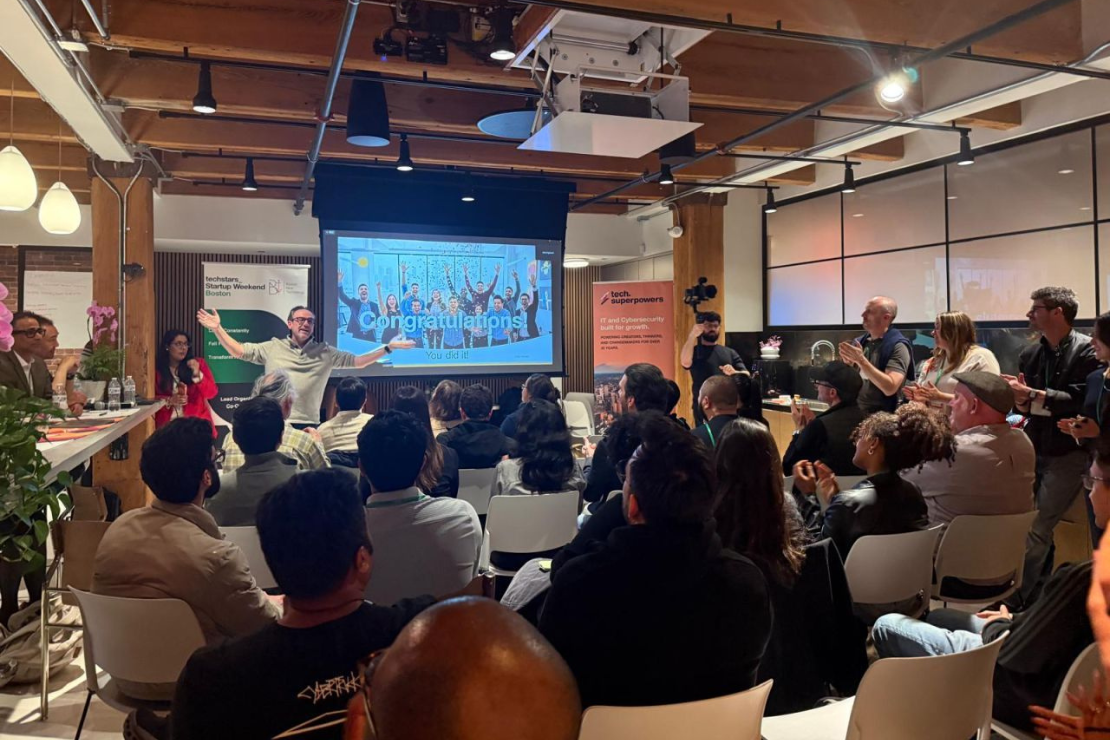
Across 54 hours from Friday evening, May 1, through Sunday afternoon, May 3, 2026, Techstars Startup Weekend Boston returned to Tech Superpowers in the South End with 51 founders forming 20 teams, supported by 50+ mentors and Entrepreneurs in Residence.
By Sunday afternoon, 18 teams had pitched products built from scratch over the weekend, four prizes had been awarded, and a network of relationships had taken shape that will continue through Boston Tech Week and beyond.
Building on the 2025 foundation, this year's event was a study in what happens when a city's startup community shows up for itself, and in what gets revealed when 54 hours of compressed founder work meets the discipline that makes such work productive.
Lead Organizer Shweta Agrawal and Co-Organizer Steve Vilkas were joined by Sergio Ferreira, veteran Techstars Facilitator, and a well-rounded volunteer squad of 10+ individuals from all over the world.
The Headline: AI Is the Cheapest Part Now
The 2026 cohort arrived during what the broader industry was calling an AI-themed moment. Most teams used AI to prototype, pitch, and build. The weekend's Champion turned out to be a glove with a toothbrush sewn into the index finger.
Brush Gloves — a toothbrush dogs actually let you use — won first place with no AI, no agents, no LLM wrappers. A four-person team consisting of a three-time founder, two German medical students from Boston Children's and Brigham & Women's, and a credentialed dental hygienist built a working physical prototype across the weekend, validated demand through 214 customer surveys, and demoed the product on a real corgi.
Judge Vlad Dobrovolski named the lesson directly: "AI is the cheapest part of your product now. Everyone has it. What separates you is whether you're solving something a human will actually pay for."
That insight — that the binding constraint in 2026 has moved from technology to problem selection — is the through-line of this year's report.
Founder Growth: Shweta's Hypothesis, Revisited
In 2025, we identified Shweta's Hypothesis: startup breakthroughs tend to wobble. Founder growth is not linear; dips, pivots, and reversals are not setbacks, but indications of real growth potential.
2026 confirmed it and sharpened it.
All four prize-winning teams transformed radically over the weekend. Brush Gloves rebranded mid-weekend, finding sharper product positioning by letting the original thesis die. Reframe — third place, a solo founder's complete content engine, from 5 hours to 15 minutes — more than doubled in size across the weekend, scaling from a non-technical trio into a seven-person team with engineering depth. Gamer Grind — second place, gamification that turns gamers into their best selves — emerged around a solo founder's work and won within hours of becoming a team. Fresh Alert — Community Favorite, the app that watches your fridge for you — won the room's vote.
2026 added two refinements worth naming.
The transformation has to close. Teams that iterated radically and resolved — finding the engineer, finding the co-founder, finding the sharper positioning — ended stronger. Teams that began transformations they couldn't complete ended up polished but structurally incomplete. The discipline isn't just a willingness to change; it's converting change into resolved structure within the time available.
The transformation is rarely visible while it happens. What we observed across the weekend was not teams forming in real time but teams emerging into legibility. Brush Gloves did not decide Sunday morning to rebrand; the rebrand had been taking shape across Saturday's customer conversations. Reframe's growth was the surfacing of relationships and conversations that had been emerging quietly across the weekend. The work happens beneath the surface; the documentation catches up only when teams stabilize.
The hypothesis, then, is the surface phenomenon of three coordinated founder disciplines operating under time pressure: constant learning, fearless engagement with failure, and the willingness to transform radically and rapidly. The teams that won were the ones whose posture made transformation productive rather than destabilizing.
Judge Nathan Spielberg captured the rubric the winners shared: "The teams that stood out weren't the ones with the flashiest demos. They were the ones who could answer five questions cold: What problem are you solving? Who has it? Why now? How do you make or save money? Why are you the team to build it? Clarity of storytelling often always wins."
Ecosystem Cohesion
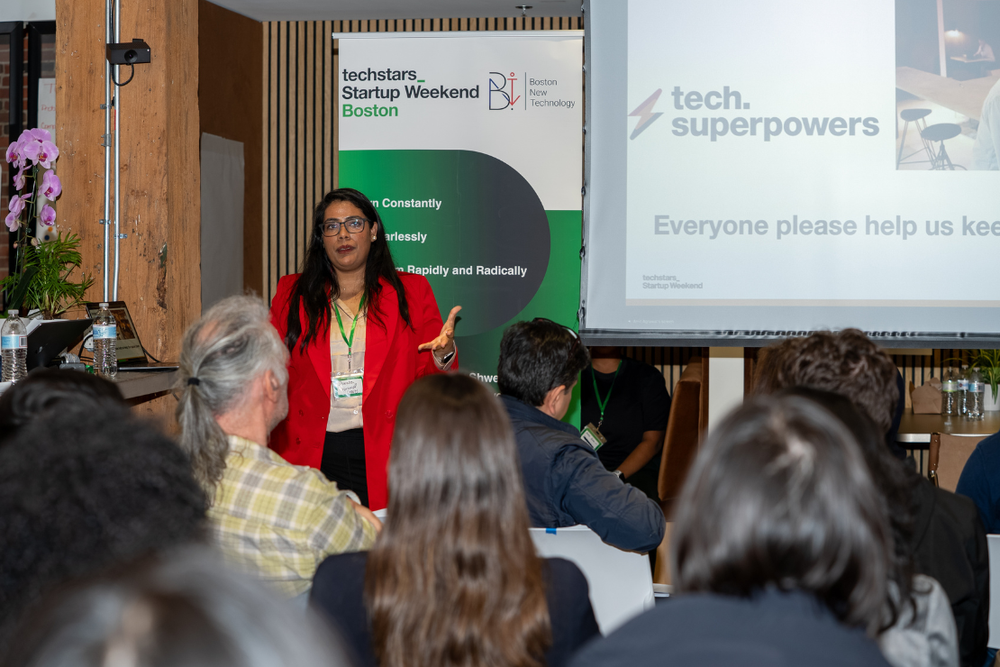
Startup Weekend Boston drew its power from the community. More than 50 mentors and Entrepreneurs in Residence — spanning legal, product, design, storytelling, engineering, finance, and operations — gave generously of their time. Several invested sustained, named attention in specific teams: mentor Amisha Thakkar coached both Brush Gloves and Fresh Alert, leaving her with the deepest visible footprint on the weekend's outcomes.
Mentor Andrey Shakirov, who served as both engineering mentor and the cohort's spirit-keeper, captured the village-level effort: "It takes a village to build a startup in three days, and this community showed up in a big way." Mentor Jessica Sahagian named what the 54-hour container produces: "The experience is demanding by design. It pushes teams to test ideas quickly, validate with customers boots-on-the-ground style, refine their thinking, and execute under pressure. It is a strong example of what makes the Boston startup ecosystem so exciting."
Across the cohort, founders completed approximately 1,000+ customer conversations across 48 hours. EIR Mourad Mokrani, who first encountered Boston's startup community as a high school senior at TiE Young Entrepreneurs and returned this weekend in an advisory role, captured the compounding effect: "This past weekend, I experienced being on the other side of the table and witnessed that exact process taking place, but in 54 hours of straight grinding. The energy was electric, where over 100 people came together to support each other with identifying problems, focusing on which customers to serve, methods of problem solving, and going through multiple rounds of iteration."
The participants felt the same compounding from the founder's seat. Taneesha Peoples, a Chief People Officer who pitched a thesis around making internal-promotion decisions transparent and equitable, wrote afterward: "I joined Techstars Startup Weekend Boston. A 54-hour sprint where founders, builders, and people with an idea and a little nerve come together to see if something is real or just sounds good in their head. The mentors were incredible. The participants were incredible. Being around people who are in this ideation space day in and day out was everything." Her solo Friday-night idea found its weekend CTO in Bobby Lough, who built a working prototype that brought the concept to life on stage.
Aaron Berger, who pitched a live-music product called The Gathering Ground, wrote: "I got to play 'CEO' (wildly under-qualified) for a weekend to solve a very real problem in the live music industry. The result is a very real app that we are planning to launch in New England." That arc, from idea pitched on Friday to product planning real-world launch by Monday, is the program's most telling outcome, distributed across teams who didn't take home a trophy.
Looking Ahead
The relationships formed over this weekend will continue. The four prizewinners have received formal invitations to The Startup Oasis Network, scheduling for their Greenberg Traurig legal sessions, and invitations to the Startup Weekend Reunion, a curated summer dinner with founders, investors, and community champions from across the Boston ecosystem.
Additional ecosystem programming will be announced in the run-up to Boston Tech Week, where several alumni teams from this cohort are expected to participate.
For 2027, we will continue to develop Shweta's Hypothesis as the program's core intellectual instrument, testing the transformation-must-close corollary deliberately, designing for the emergence-into-legibility pattern we observed this year, and continuing to refine the founder disciplines that produce wins.
Final Word
EIR Shreya Singh, reflecting on the weekend from the seat of a founder-mentor — she runs No Bad Days Club, formed at Techstars Startup Weekend Boston 2025, and captured the lesson the cohort lived in language the cohort itself was reaching for:
"54 hours. Teams sprinting from ideation to demo. One lesson hit harder than expected: the difference between a vision and a goal. Visions inspire. Goals give direction. And in a 54-hour pressure cooker, you learn fast that direction and constraints are gifts."
"Teams that picked one goal shipped. Teams that chased the vision spiraled. Watching founders wrestle with this in real time was a mirror for No Bad Days Club. We're in beta. The temptation to chase every possibility is real. But the weekend reminded me: help with one thing. Solve one problem. Nail one goal."
That is the spirit Boston brought to the room this May. And it is the spirit we will bring to 2027.
The impact is real, the momentum is building, and the future is bright.
— Shweta Agrawal (Lead Organizer) & Steve Vilkas (Co-Organizer)